In 2016 I had the chance to invest in SpaceX at a $12 billion valuation through an SPV. I passed. The valuation felt rich, I underestimated the size of the market, and I underestimated Elon Musk. I also sat out the entire Tesla run that followed.
Ten years later the company is worth more than 100× that number and is now public. The natural question is: is it too late?
The only useful way to answer that is to stop looking backward.
First Principles, Not Regret
Every investment decision has to be made with the information available at the time of the decision. The fact that I missed SpaceX in 2016 is emotionally loud and analytically irrelevant.
Carrying the weight of a past miss into a present decision creates two distortions:
- Anchoring to the old price — the mind keeps comparing today's valuation to the one I could have paid, instead of evaluating the business as it exists now.
- FOMO-driven urgency — the desire to "not miss it again" pushes people to act faster and with less discipline than the opportunity actually warrants.
High-yield decision making removes both. It asks only: given the current facts, expected cash flows, competitive position, and risk, does this investment offer an attractive expected return from here?
Past opportunity cost is a sunk cost. Treating it as anything else is emotional accounting, not capital allocation.
What the Numbers Actually Show Today
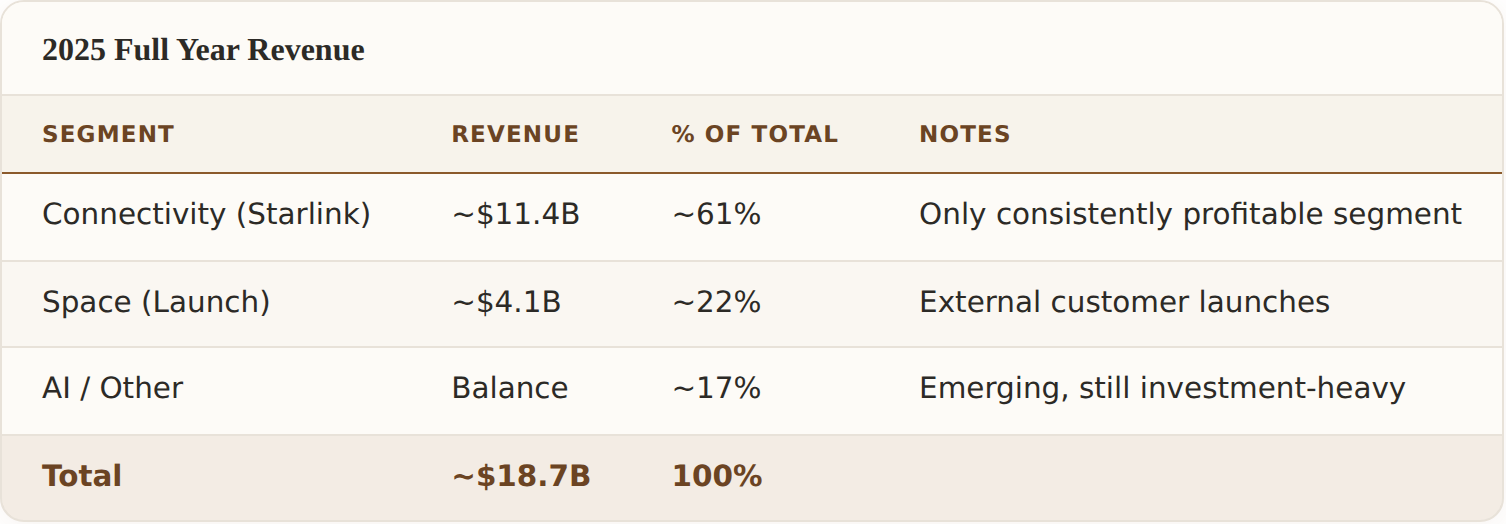
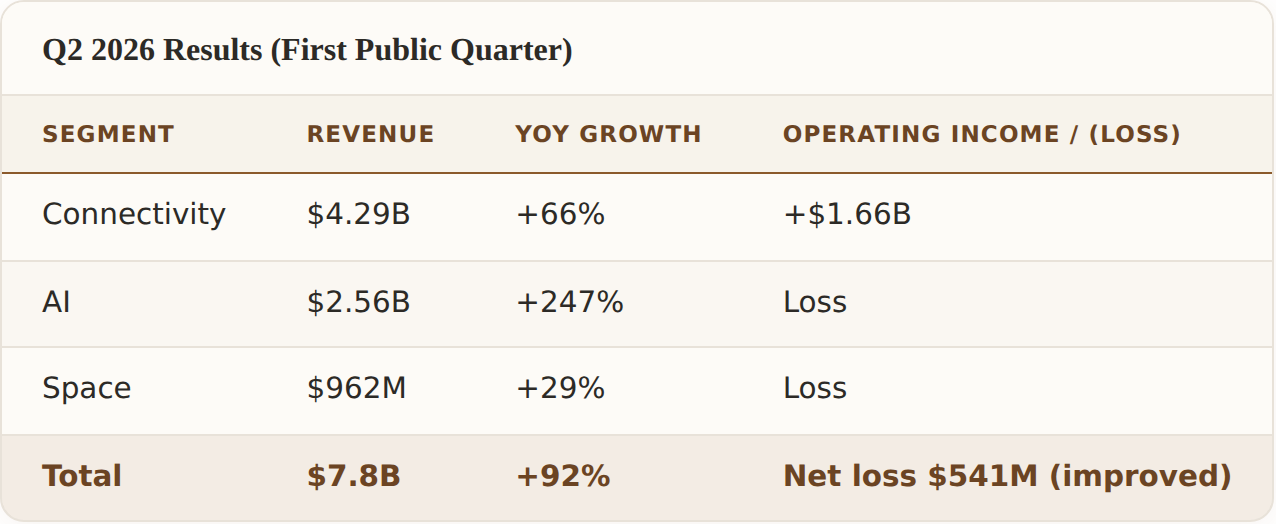
SpaceX is no longer a pure launch company. The latest public data (S-1 and Q2 2026 earnings) make the mix clear.
Starlink Unit Economics
This is the most important part of the investment case.
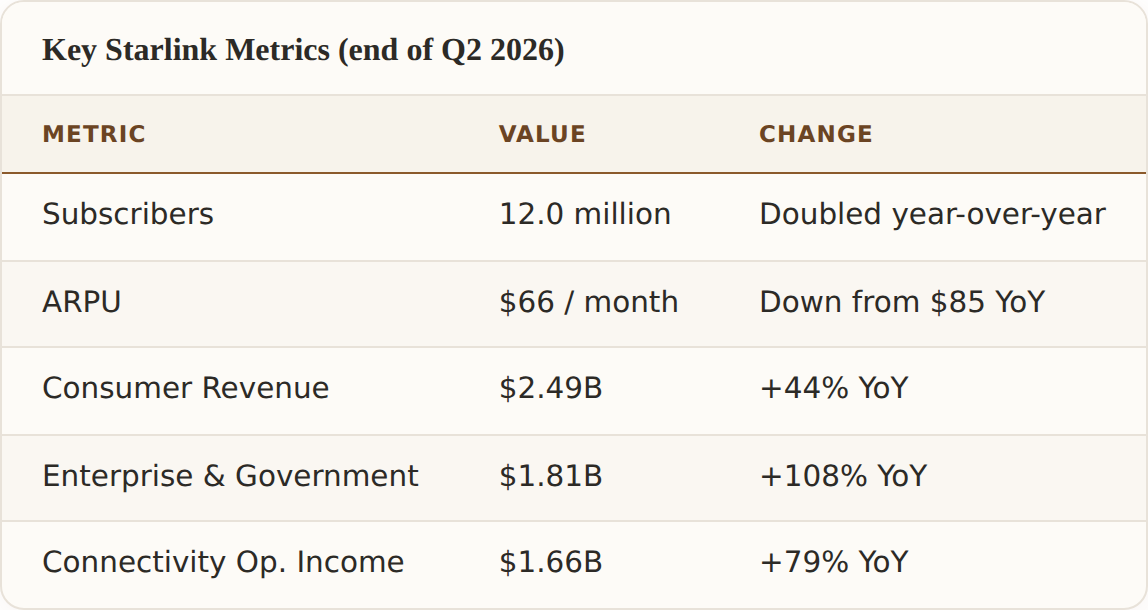
Starlink has already crossed into meaningful profitability at the segment level. In Q2 2026 the Connectivity segment generated $4.29 billion in revenue and $1.66 billion in operating income — an operating margin of roughly 39%. Full-year 2025 showed a similar profile (~38–39% operating margin on $11.4 billion of revenue).
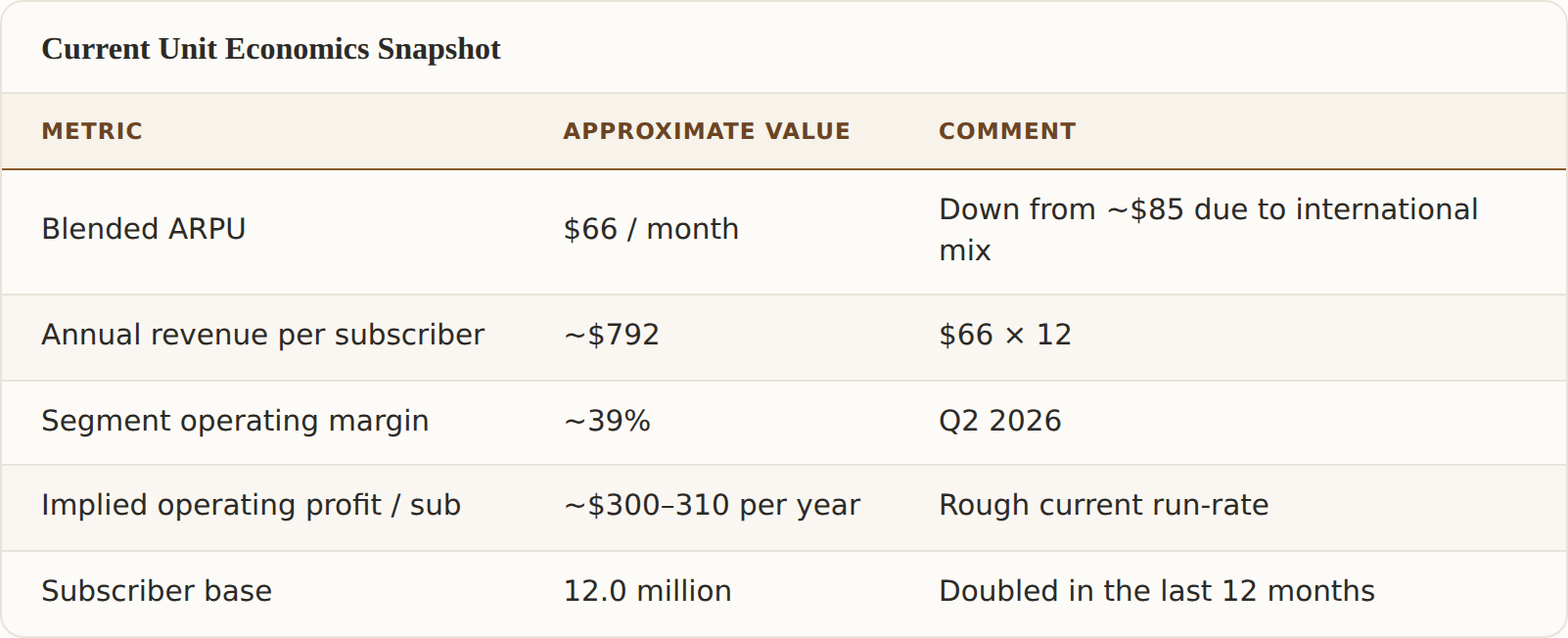
Two important dynamics are happening at the same time:
- ARPU compression — As Starlink expands aggressively into lower-priced international markets and adds more affordable plans, blended ARPU has declined. This is classic land-grab behavior.
- Margin expansion on incremental revenue — Because a large portion of the constellation and ground infrastructure cost is already sunk (or being depreciated), each additional high-quality subscriber, especially in enterprise, maritime, aviation, and government, drops a very high percentage of revenue to profit.
The mix shift toward Enterprise & Government is particularly important. That cohort grew 108% year-over-year in Q2 and now represents a meaningful share of Connectivity revenue. These customers typically carry significantly higher ARPU and lower churn than residential users.
Why the Unit Economics Can Improve from Here
- Higher utilization of existing capacity — More subscribers and higher data usage per user improve returns on the satellites already in orbit.
- Starship-enabled V3 satellites — Much higher capacity per satellite should drive down cost per bit meaningfully over the next 2–3 years.
- Fixed-cost leverage — Launch, satellite manufacturing, and ground network have high fixed costs and low marginal costs once scaled.
- Enterprise & government mix — Continues to rise and carries better pricing power and longer contracts.
The current ~39% operating margin is already strong for a still-scaling infrastructure business. If Starlink can stabilize or grow ARPU while continuing to add subscribers and improve the enterprise mix, incremental margins should remain attractive for a long time.
Forward Guidance from the Latest Earnings Call
Management stated they are targeting a $100 billion annualized revenue run-rate by the end of 2026. Elon Musk separately pulled forward the long-term ambition of $1 trillion in annual revenue to 2030 (with a "non-zero chance" of 2029), citing accelerating bandwidth demand from AI and robotics.
These are aggressive targets. They depend on continued Starlink subscriber growth, rising enterprise and government mix, Starship cadence, and successful monetization of AI infrastructure. They are not guarantees — but they set the scale of ambition against which the current valuation should be judged.
Post-IPO Dynamics and Why Timing the Exact Bottom Is a Trap
After the IPO, lock-up expirations and early investor/employee selling created mechanical supply. That pressure is real and can produce multi-month periods of price weakness even while the underlying business continues to compound.
Macro conditions (interest rates, bond market moves, geopolitical risk, and the historical pattern of technology stocks around mid-term elections) also influence short-term price action. None of them reliably identify the single best entry day.
The high-yield conclusion is straightforward: it is nearly impossible to time the precise low. For an asset you believe has a long runway, the rational approach is to decide on a position size you are comfortable holding through volatility and then dollar-cost average over a defined window — in this case the next four to five months — rather than trying to catch the perfect day.
Why This Can Still Be a Generational Position Over the Next Decade
Over a ten-year horizon the more important variables are structural:
- Launch costs continue to fall with higher flight rates and Starship reusability.
- Starlink is transitioning from pure subscriber growth toward a higher-quality mix of enterprise, maritime, aviation, and government revenue.
- Direct-to-cell and Starlink Mobile open additional large markets.
- The combination of low-cost launch + global low-latency connectivity + AI compute creates a vertically integrated platform that is extremely difficult to replicate.
- The addressable markets (global broadband, mobility, defense, and eventually orbital logistics) remain measured in the high hundreds of billions to trillions over long periods.
Companies that successfully industrialize a new domain at global scale often continue compounding for a long time after the initial breakthrough becomes obvious. The early 100× phase is behind us. That does not mean the remaining multi-bagger phase is gone — it simply means future returns will be driven by execution, margin expansion, and market expansion rather than pure technological proof-of-concept.
The right question is no longer "Could I have made 100× from 2016?" The right question is: "From today's price, with today's information and the current trajectory of Starlink + Starship + AI infrastructure, does this still offer an attractive asymmetric return over the next decade?"
If the answer is yes, then the 2016 miss is just history. The high-yield move is to evaluate the opportunity cleanly, size it appropriately, and accumulate with discipline instead of emotion.