Every cycle, the same trade shows up wearing a different mask. Price falls, sentiment breaks, the people who were loudest at the top go quiet, and the assets that made the last generation of money get relabeled as mistakes. Then, a year or two later, the same assets are back on magazine covers and everyone claims they saw it coming.
I don't have a crystal ball. I have a filter — clarity, compounding, leverage, ownership of outcome — the same one I use to treat hyperkalemia in the ED at 3 a.m. with nothing but an EKG and labs pending. That filter runs on data: cycle timing, on-chain positioning, derivatives, rates, and flows. Below is my rationale for the investment now, followed by exactly how I'm deploying capital.
Where We Are in the Cycle
Bitcoin peaked near $124,000–$126,000 in October 2025 and is now trading in the low-to-mid $60,000s. Ugly if you're anchored to the top; historically mild everywhere else.
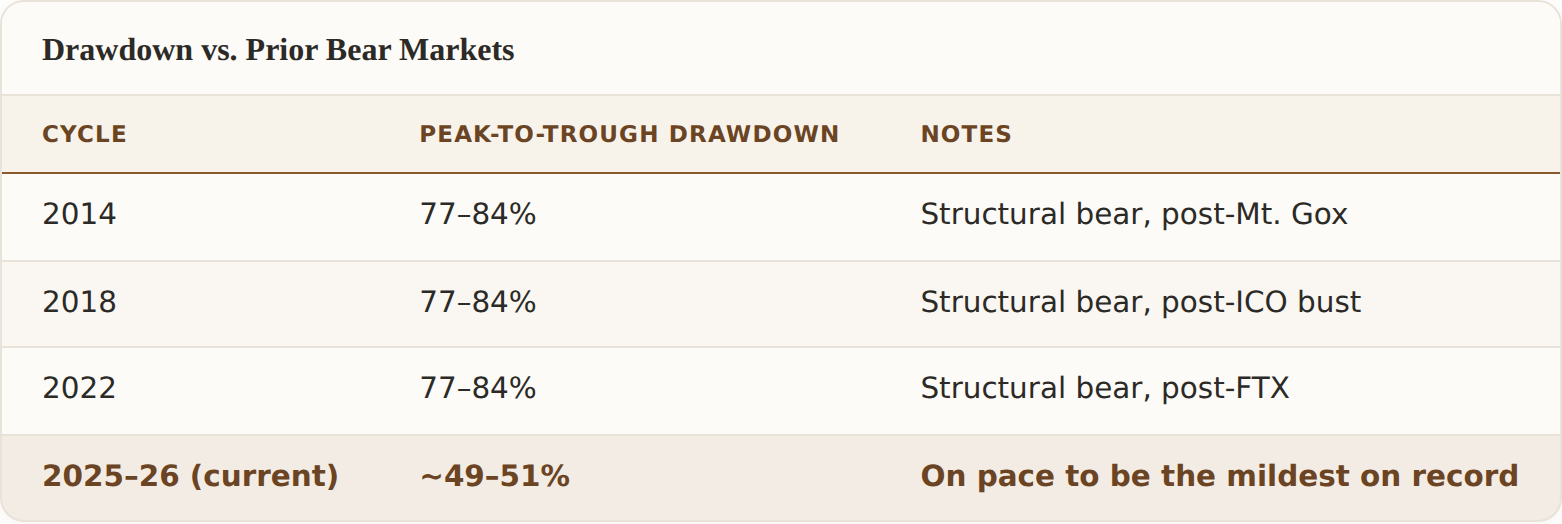
At roughly half the historical average, this is on pace to be Bitcoin's mildest bear market on record — a market-structure signal (deeper spot liquidity, ETF plumbing, a broader holder base) more than a reason for complacency.
Two timing frameworks are worth separating instead of conflating, because I've made that mistake myself in past writing:
Halving-cycle timing. The last halving was April 2024. Historically, bear-market bottoms land 26–30 months after a halving — which places the window for this cycle at roughly June through October 2026. We're inside that window now.
Election-year seasonality. Bitcoin has sold off in the August–September window ahead of every U.S. midterm in its trading history (2014: -53%, 2018: -24%, 2022: -21%), with further Q4 weakness each time. It's tempting to call this an "election effect," and I have in past writing. The more honest read: midterms fall roughly 26–30 months after halvings almost by construction, so the seasonality is probably a halving artifact wearing an election costume. Either lens points to the same window. I'd rather be right about the mechanism than just right about the pattern.
On-Chain: Are We Near a Floor?
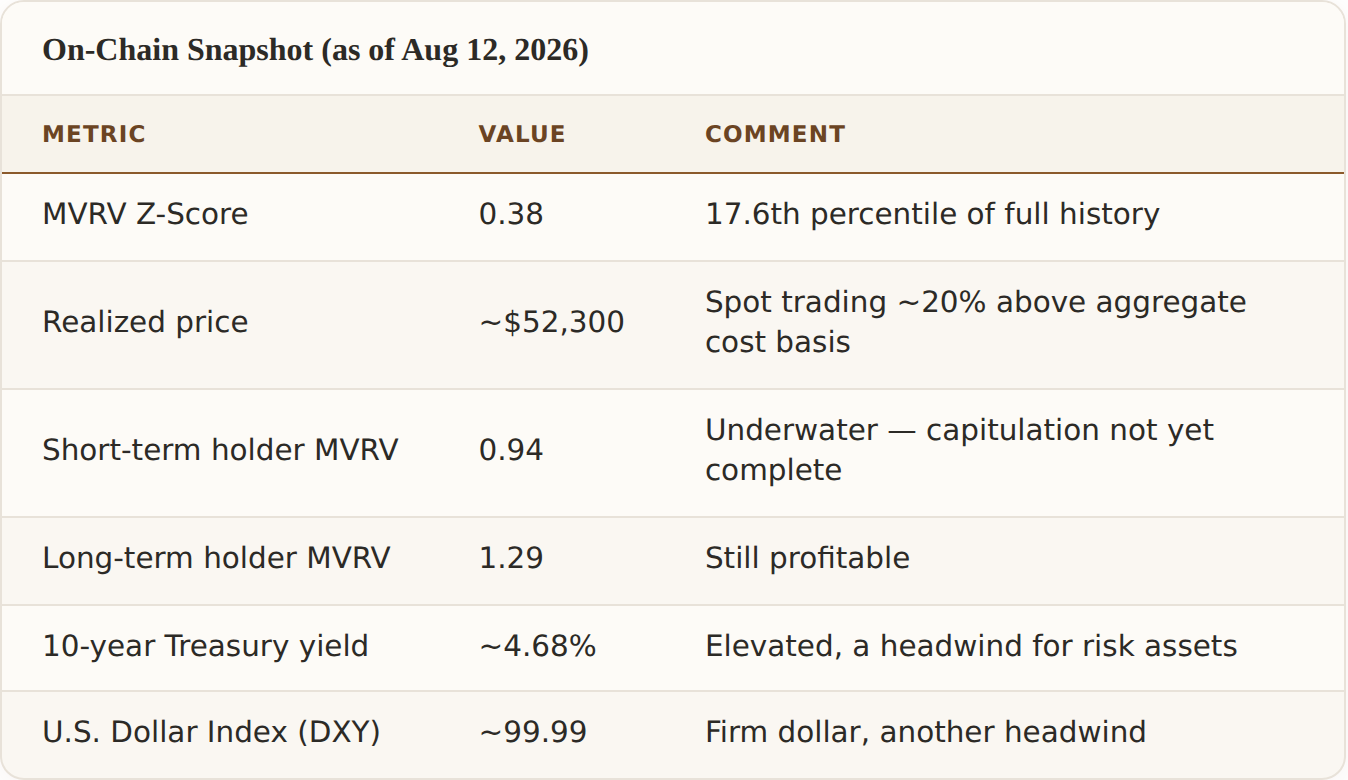
The holder-cohort data is more honest than a single headline number. Short-term holders are underwater while long-term holders remain profitable — a mixed signal, not a clean capitulation print. The classic "give up and sell at a loss" behavior that historically marks a bottom hasn't fully flushed through the short-term cohort yet. I'd also flag the counter-argument directly: elevated yields and a firm dollar complicate a pure "this is cheap" read. On-chain valuation is supportive, not conclusive.
Derivatives and Technicals: What Leverage Is Telling Us
Funding rates are where I look for positioning that price alone won't show. In March–April 2026, seven-day average funding on BTC perpetuals dropped to roughly -0.005% — the most negative since 2023, meaning shorts were paying longs to stay short.
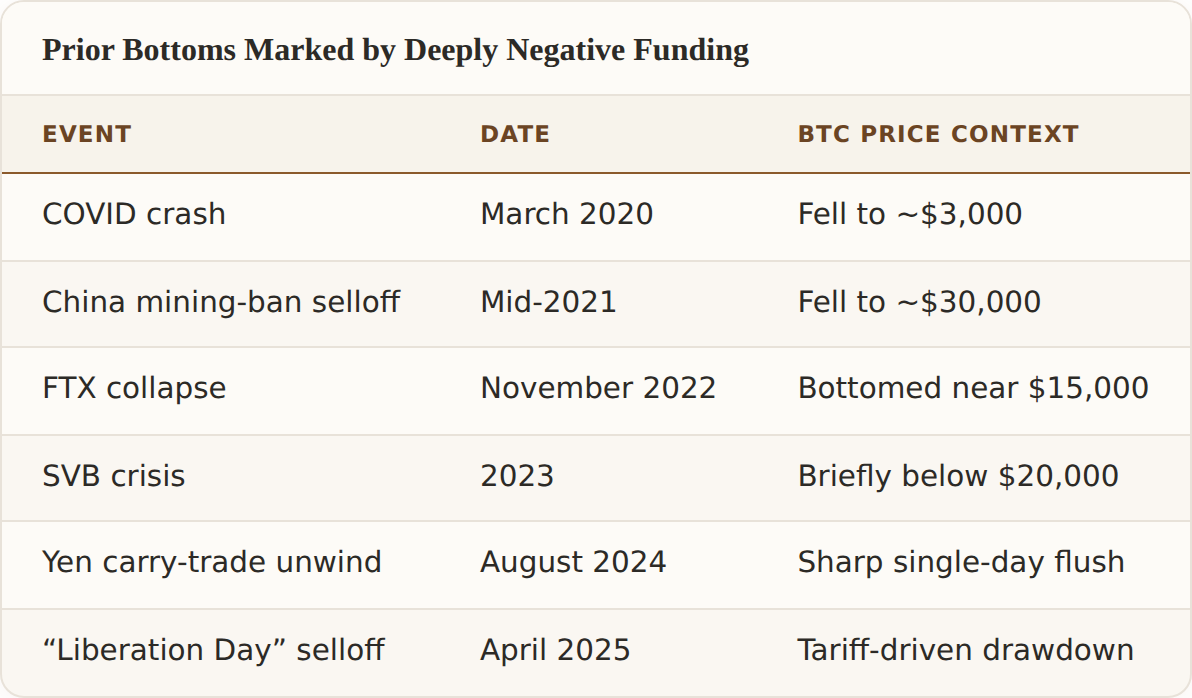
That setup produced exactly the squeeze the pattern predicts — BTC ran from the mid-$60,000s to roughly $75,000 through late March and April as crowded shorts got unwound. It then rolled back into the low-$60,000s by summer. I'm noting the failure, not just the pattern, because a grinding, two-steps-forward-one-back bottom is more common historically than a clean V, and pretending otherwise would be disingenuous.
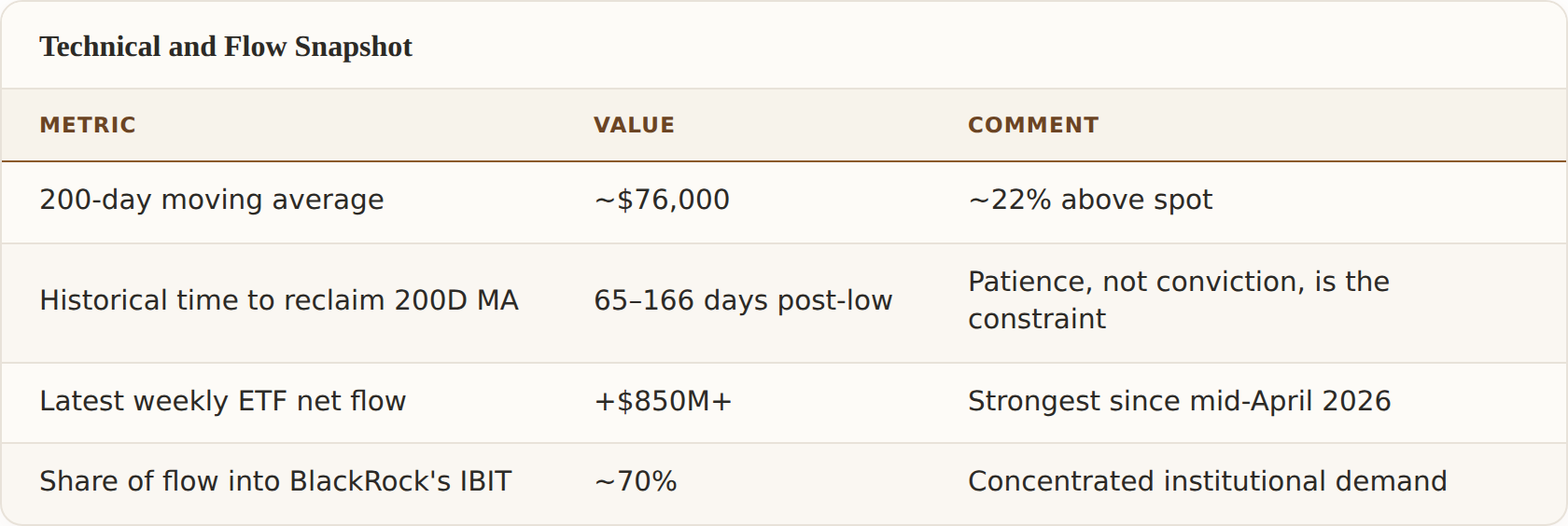
Institutional accumulation persisting through a sideways-to-down tape, while retail interest stays near multi-year lows, is the combination I want to see this deep into a drawdown.
The Fed, Rates, and the Warsh Factor
New Fed Chair Kevin Warsh held the funds rate at 3.5–3.75% in his July 2026 testimony to Congress, stating the Fed has "no tolerance for persistently elevated inflation." He's running five task forces — on communications, balance sheet policy, data, productivity, and the inflation framework itself — which is a methodical, institutionalist posture, not the fast-easing pivot crypto bulls were pricing in earlier this year.
Two things matter more than the headline rate:
- Balance sheet review — could tighten financial conditions even alongside future rate cuts. Crypto, especially higher-beta parts of it, has historically been more sensitive to broad liquidity than to the funds rate in isolation.
- AI-driven productivity framing — Warsh leans on high-tech equipment investment (up ~25% year-over-year) as the mechanism that could let the Fed cut without reigniting inflation, but he's explicit that "we don't know the extent to which the economy will benefit." That uncertainty cuts both ways for risk assets: constructive if productivity gains show up, a source of policy whiplash if they don't.
Rotation: BTC → ETH → Alts, and Why We're Not There Yet
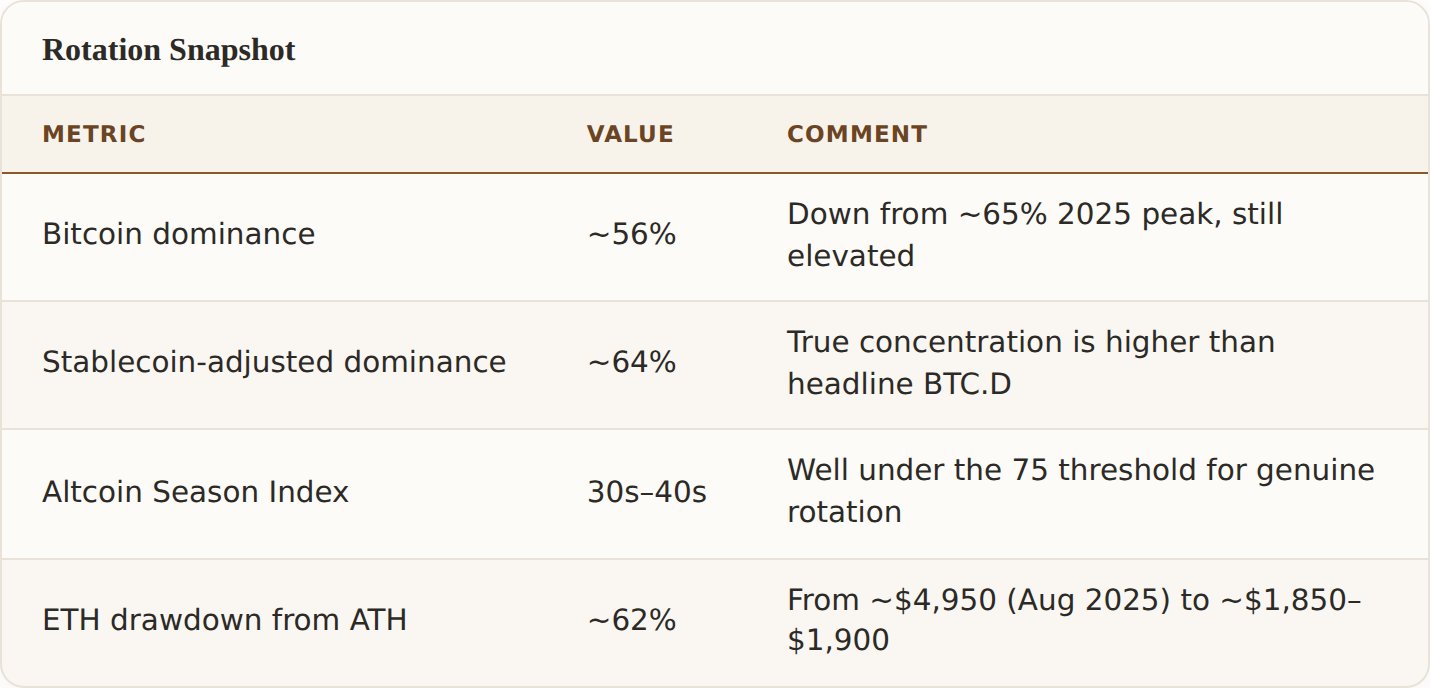
Capital hasn't left Bitcoin for the rest of the market yet. That matches the pattern from every prior cycle — BTC stabilizes first, ETH and large caps follow, mid- and small-cap alts move last and hardest.
Ethereum is down more on price than BTC, but the usage data is diverging from the price chart. Ethereum anchors a real-world-asset settlement market north of $26 billion, and staking participation and active addresses have held up while price has not. Usage up, price down, is usually where the yield gets built for people willing to be early and boring at the same time.
The Cowboy Standards Filter
I run every allocation through the same four questions I use for everything else:
- Clarity under incomplete information. I don't need to know the exact bottom. I need to know whether supply, demand, and structural trend are intact, and whether the data supports that read from more than one angle — cycle timing, on-chain, derivatives, and flows all pointing the same direction is what "intact" looks like.
- Non-negotiable quality on compounding matters. Long-duration capital allocation is a compounding decision, not a trading decision. I'm not swinging this on leverage or trying to time the exact low. Cheap conviction is like cheap boots — it costs you more later.
- Refusal to waste motion. Sitting in cash "waiting for confirmation" is its own decision, and historically it's been the expensive one. Waiting for the 200-day moving average to reclaim has, in past cycles, meant paying up 20–30% more for the same asset.
- Self-reliance without isolation. I self-custody a small position and use regulated venues and ETFs for a portion of size and liquidity.
How I'm Actually Deploying Capital
No hero trades, no all-in. I have been dollar-cost averaging into both BTC and ETH over the past 1-2 months, and in the process of completing my total buys - sized so that a further 20–30% drawdown is a buying opportunity, not a margin call.
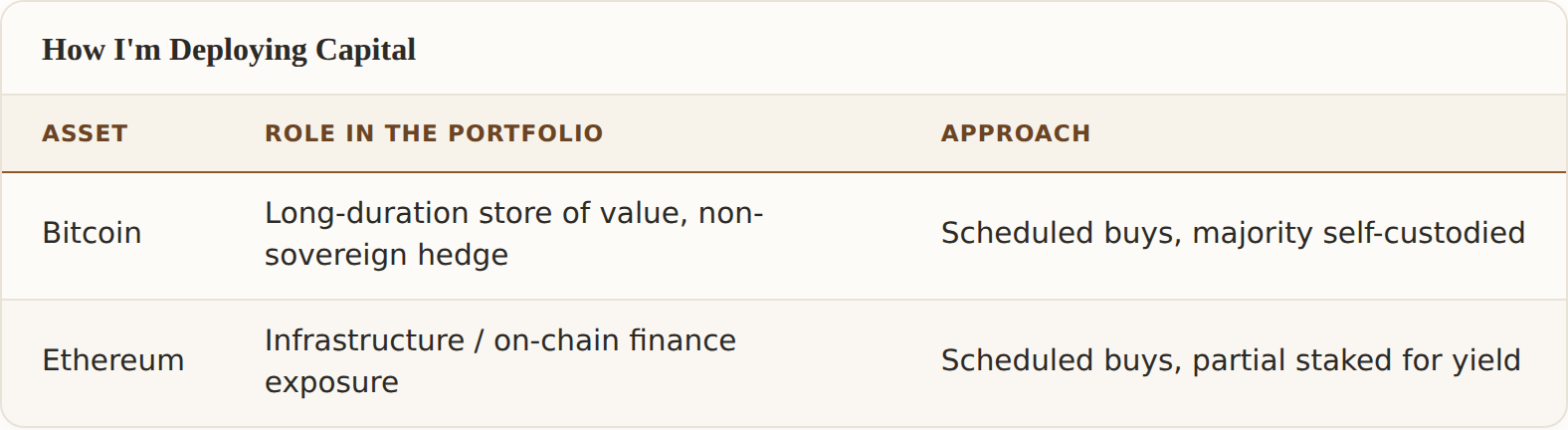
This is sized against a decade-long horizon, funded out of the cash I created for myself last year, and with some income I am earning.
The Honest Risk Side
This isn't guaranteed, and the data above cuts both ways if you squint. The 200-day moving average sits meaningfully above spot, and reclaiming it has historically taken months. The April 2026 funding-rate squeeze to $75,000 already rolled over once — the next one could too. Warsh's Fed could hold rates higher for longer than the market wants, and a balance-sheet review aimed at "getting the regime right" could tighten conditions instead of easing them. Bitcoin dominance could keep climbing instead of rotating, which would mean ETH and alts lag longer than I'm modeling. Protocol-level risk, regulatory risk, and the plain fact that both assets are still early and volatile are all real. Position size accordingly — mine is sized so that being early doesn't wreck me, and being wrong doesn't either.
None of this is financial advice. It's how I'm thinking about my own capital, at my own risk tolerance — not a recommendation for yours. Do your own diligence, or find someone who'll do it with you.
Bottom Line
Bear markets are where the yield gets made, not where it gets found later. Cycle timing, on-chain positioning, derivatives history, and institutional flows are all pointing the same direction at the same time — that alignment, not any single data point, is what makes this a buy for me rather than a guess. I'm not trying to call the bottom. I'm trying to own the right assets at a fair average price by the time the story flips back to obvious — because by then, it won't be cheap anymore.
High yield or nothing.